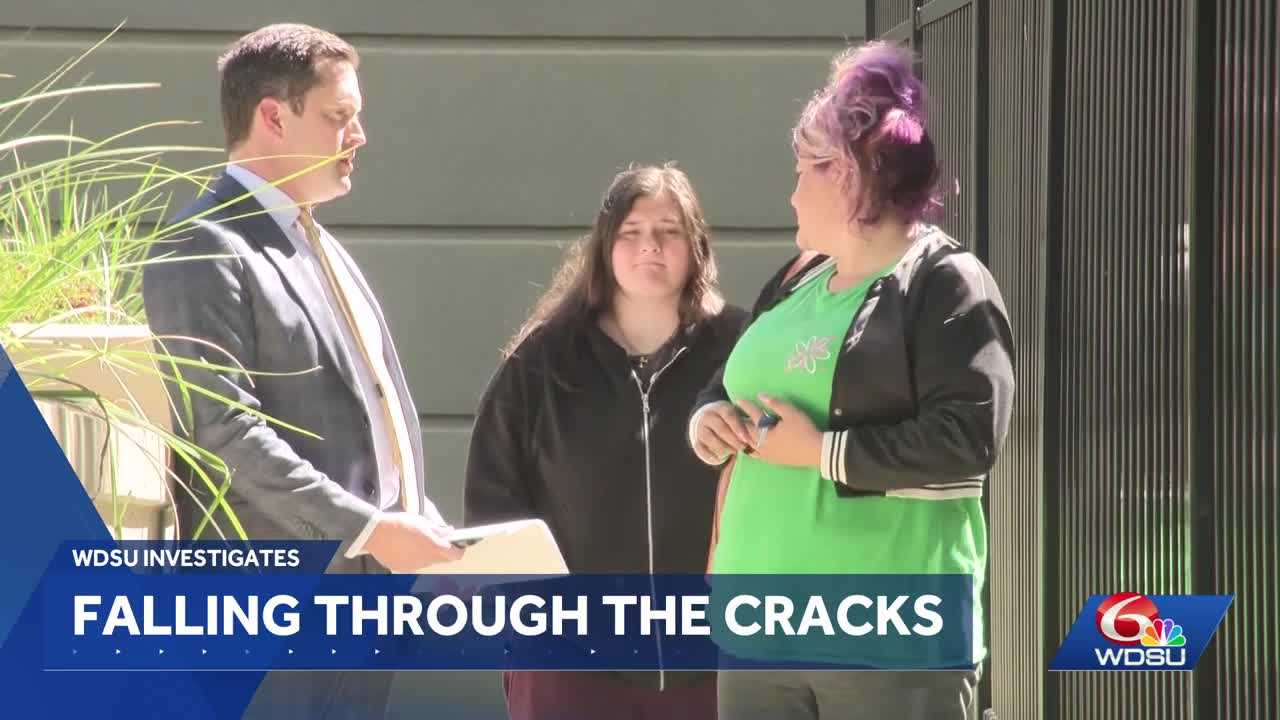
A Jefferson Parish mother says her deaf daughter has struggled to get the support she needs at school, prompting her to turn to WDSU Investigates to share her daughter’s story and help other children.
Lauren Fricano says her daughter, Alicia Lapoint, was born prematurely and deaf and has been fighting for the past 15 years.
“My name is Alicia Lapointe,” Lapoint said, struggling to form words in an interview with WDSU.
Fricano said her daughter was a ninth grader at John Ehret in Marrero. She claims the school at times did not provide all the resources her daughter needed to succeed.
“She is about to cry; it’s been really hard on her,” Fricano said.
Fricano claims an interpreter was not always present and Alicia was placed in classes beyond her level without the support required by her individualized education program, or IEP.
“It breaks my heart. It really breaks my heart that she feels this way about her education,” Fricano said.
WDSU Investigates requested an on-camera interview with Jefferson Parish Schools.
They issued a statement that reads:
“Jefferson Parish Schools provides specialized services and supports for students who are Deaf or Hard of Hearing, including interpreting services, classroom accommodations, specialized instruction, and other supports based on individual educational needs.
Each student’s services are determined through the Individualized Education Program (IEP) process, which brings together parents and relevant educational professionals to identify the student’s needs, establish appropriate services and accommodations, and support access to instruction and participation in school.
The district takes concerns regarding the delivery of student services seriously. When questions arise about a student’s services or implementation of an IEP, those concerns should be addressed through the appropriate district processes so they can be reviewed and responded to based on the student’s individual circumstances.
Because student educational information is confidential, Jefferson Parish Schools cannot comment on an individual student’s situation. We remain committed to working with families and school teams to support students’ individualized educational needs.”
WDSU Investigates also examined data from the Louisiana Department of Health’s Louisiana Commission for the Deaf interpreter registry, which launched this year. It lists 96 active profiles statewide.
“Of those, 49 reported being available anytime to accept appointments involving children upon request. Those interpreters are independent contractors open to accepting assignments. The remaining interpreters may already work full time elsewhere and may not be available to be contacted for an assignment.”
Janna Broussard, with the Louisiana Commission for the Deaf, said approximately 8% of Louisiana’s population — about 360,000 people — are identified as deaf, deafblind or hard of hearing, including people who have experienced age-related hearing loss.
Among children, 1,032 students are registered within the Department of Education system, according to data from July 2024.
The state Department of Health is launching new funding and programs to increase the number of sign language interpreters. Interpreters have until January 2027 to register with the state.
Fricano said the Louisiana School for the Deaf has accepted her daughter.
While Fricano claimed an interpreter wasn’t always provided enough, records she provided WDSU did show the school communicated with her about her concerns to provide interpreters to ensure her daughter had necessary resources.
Fricano said she hopes anyone watching her daughter’s story takes a moment to think about others fighting to be heard.
For additional details on resources, check out the information below:
“In Louisiana, public and private service providers have always been required to secure qualified sign language interpreters, but until now, there has never been a clear statewide definition of what ‘qualified’ means,” said Jana Broussard, acting executive director of the Louisiana Commission for the Deaf. “These regulations provide clarity for both providers and recipients receiving sign language interpreting services and help ensure interpreters are appropriately qualified for the setting they are working in.
Beginning July 1, 2026, sign language interpreters may apply to join the updated online registry of interpreters who meet the state’s new qualification and training standards. Registration will be required to provide sign language interpreting services in Louisiana.
The Louisiana Commission for the Deaf also offers resources and professional development opportunities to help interpreters meet the new qualifications. The Commission’s Interpreter Mentorship Program offers one-on-one coaching, study groups, job shadowing opportunities, internships, and continuing education units.
To learn more about the Louisiana Commission for the Deaf and the new qualification standards, visit lcd.la.gov or email LCD@la.gov.
READ MORE:Deaf Marrero student struggles for resources as state only has 96 registered interpreters